 English




S3-5: Xiao Lin, the Account Manager: A 3 a.m. WhatsApp, and Why We Answer in Arabic
Published: 2026-09-04 | Series 3: The People — Profile 5 | Reading time: 7 minutes
Xiao Lin, the Account Manager: At 3 A.M., She Answered a WhatsApp Message
Xiao Lin's phone does not have a silent mode. Not anymore.
She is 【待填:年龄】, from 【待填:籍贯】, and she is the factory's account manager for the Middle East and Southeast Asia — which means her working day is never quite over, because her clients' working day is always just beginning, or just ending, on the other side of the world.
Dubai is four hours behind Dongguan. Riyadh is five. Jakarta is one. When Xiao Lin is having dinner, her clients are having lunch. When she is asleep, they are at their desks, looking at samples, comparing quotes, deciding.
She learned, early, that the difference between a factory that gets the order and a factory that does not is often not the price, or the quality, or the speed. It is the answer.
The message.
The message came at 3:07 on a Wednesday morning.
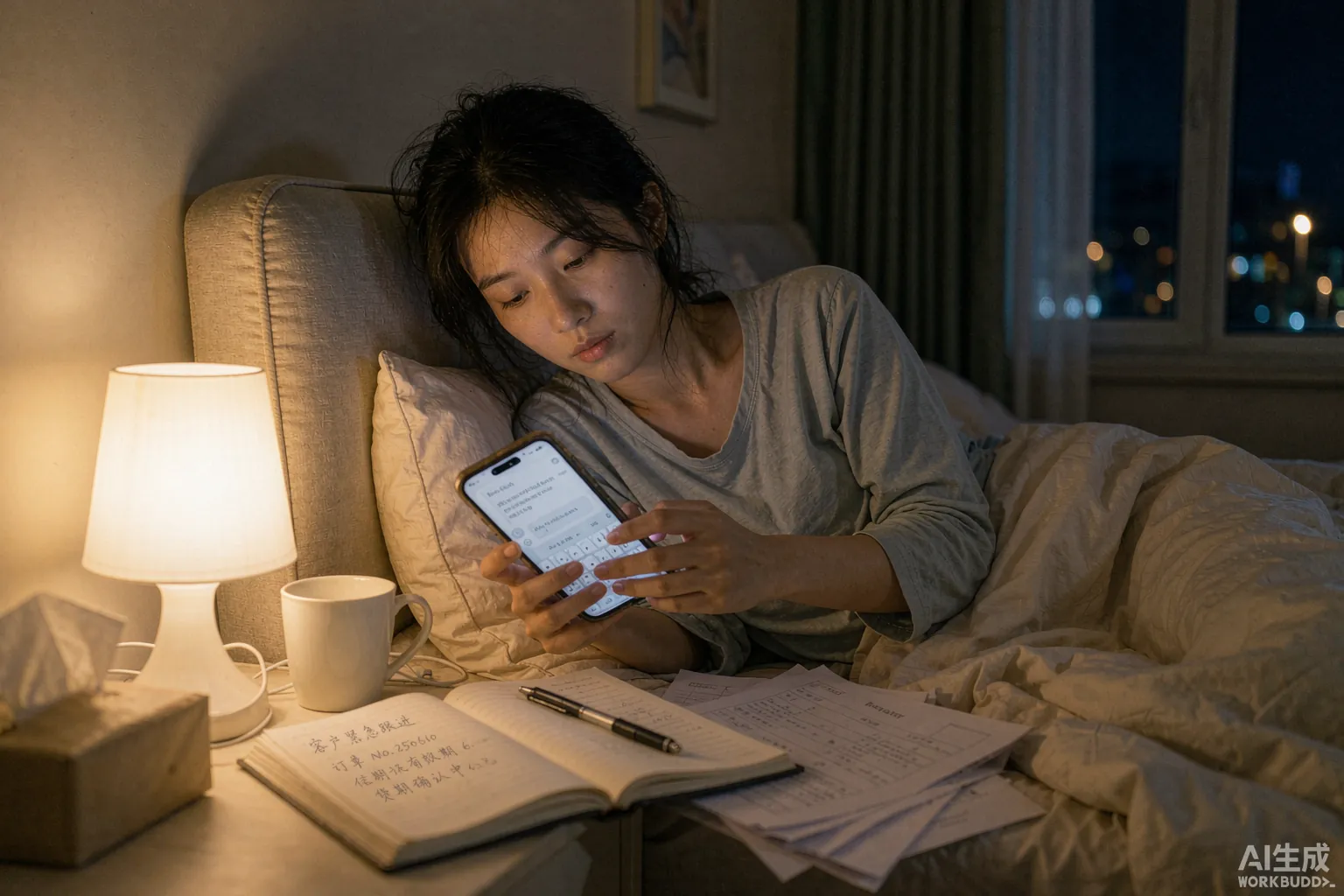
Xiao Lin was asleep. Her phone lit up, and she woke, the way she has trained herself to wake — not all the way, just enough. She looked at the screen. It was a client in Riyadh, a new one, three messages in, still deciding between this factory and one other.
The message was in Arabic. Xiao Lin does not read Arabic. But she has learned, over two years, to recognize the shape of a question, and she has a translation app, and she has, more importantly, learned the twenty or thirty Arabic words that matter — marhaba, hello; shukran, thank you; kam al-thaman, how much; mumkin, is it possible.
She translated the message. The client was asking about the foil. Could the factory match a specific shade of gold, a shade from a box they already had, a box made by someone else?
It was 3 a.m. The foil master, A Zhen, was asleep. The sample room was dark. No one could answer the question, not really, not until morning.
Xiao Lin could have waited. She could have replied at 8, when the factory opened, with a full answer. That is what most people would do. That is what the other factory, probably, was doing.
She did not wait.
What she did.
She got out of bed. She turned on the light. She took a photo — not of a box, because she had no box, but of the shade card, the foil swatch book that she keeps, for exactly this reason, on her nightstand. She found the closest shade. She photographed it. She typed, in English, slowly, because the client was not fluent either:
"Marhaba. Yes, we can match this. This is our closest foil — I will confirm with our master in the morning and send you a physical swatch by courier tomorrow. The color will be the same. I promise."
Then, because she had learned that a little Arabic goes a long way, she added: "Shukran for your trust."
She sent it. It was 3:19 a.m. She went back to bed.
The client replied at 3:24 — 7:24 in Riyadh, the start of their day. It was one word, in English: "OK." Then, a moment later: "You are the only one who answered."
The factory got the order. It was not a large order. But it was the first, and there have been five since, and the client, in a message Xiao Lin keeps a screenshot of, once told her why they chose this factory over the other one, the one that was cheaper:
"You answered at 3 a.m. The other factory answered the next day. I thought: if they answer at 3 a.m. for a question, they will answer at 3 a.m. for a problem."
The swatch book on the nightstand.
The swatch book on the nightstand is Xiao Lin's own idea. No one told her to keep it there. She started keeping it after the first time a client asked, at midnight, whether the factory could match a color, and she had to say, "I'll tell you in the morning," and the client said, "The other factory already said yes."
She lost that order. She does not lose them anymore.
Now she keeps the swatch book, and a small light, and a notebook with the Arabic words, and a charger, always, on the nightstand. She has learned to wake at the sound of a message, to read it, to decide whether it can wait until morning or whether it cannot, and to answer, in the middle of the night, in two languages, with a photograph of a shade of gold.
Her friends think she is crazy. Her mother tells her to turn off the phone, to sleep, to take care of herself. Xiao Lin tries to explain.
"It's not the phone," she says. "It's that on the other side of the world, someone is deciding whether to trust us. And trust doesn't wait until morning."
The two languages.
Xiao Lin's English is good. Her Arabic is twenty words. She is not ashamed of this. She has learned that you do not need to be fluent to be understood — you need to be present.
She has learned the words that matter. Marhaba, to begin. Shukran, to thank. Mumkin, is it possible — the word every client uses, the word that means they are about to ask for something. Na'am, yes. La, no — though she has learned to say it softly, in English, with a reason, because a bare la can end a conversation.
She has learned, too, the things that are not words. She has learned that a client in the Gulf does not want a long email. They want a short answer, a photo, a voice note, a video of the box being made. She has learned that WhatsApp is not a chat app, it is the whole relationship — the quote, the sample, the proof, the shipment, the complaint, the reorder, all of it, in one thread, with one person, who answers at 3 a.m.
She has learned that the client is not buying a box. The client is buying the certainty that, when they have a question, someone will answer it.
She is the someone.
The time zones.
There is a map in Xiao Lin's notebook, hand-drawn, of the world's time zones. Dongguan is in the middle. To the left, Dubai, Riyadh, the Gulf — four, five hours behind. To the right, Jakarta — one hour ahead. She has drawn arrows, and written the hours, and circled the overlap — the few hours each day when she and her clients are both awake.
The overlap is small. Four hours, maybe five, in the afternoon and evening, when Dongguan's day is ending and the Gulf's day is at its height. That is when the real work happens — the quotes, the negotiations, the decisions.
But the trust is built in the other hours. The 3 a.m. hours. The hours when a client, alone at their desk on the other side of the world, sends a question into the dark, and waits, and wonders if anyone is there.
Xiao Lin is there. She has made it her job to be there.
Wednesday, again.
It is Wednesday again, a year later. Xiao Lin is asleep. Her phone lights up. She wakes, the way she has trained herself to wake.
It is the client from Riyadh. Not a new client anymore — an old one now, five orders in, a friend, almost. The message is not a question. It is a photo — a photo of a box, on a shelf, in a shop in Riyadh, a box that Xiao Lin's factory made, a box whose shade of gold she matched, at 3 a.m., a year ago.
Under the photo, three words, in English: "It sold well."
Xiao Lin looks at the photo for a moment. The box, on a shelf, in a city she has never seen, holding a perfume she has never smelled, bought by a person she will never meet.
She types back, in English, then in Arabic, the twenty words she knows: "Shukran. Marhaba to your family. The next order will be even better."
She sends it. It is 3:19 a.m.
She puts the phone back on the nightstand, next to the swatch book, next to the notebook with the Arabic words, next to the charger.
She goes back to sleep.
Profile 5 of "The People" series — the one who answers a WhatsApp at 3 a.m., who learned Arabic on a folding bed in the corner of the office, and who is the only reason the clients know the factory by name.