 English




S3-2: A Zhen, the Foil-Stamping Master: Her Hands Are Truer Than the Machine, and They Hold Up a Family
Published: 2026-09-04 | Series 3: The People — Profile 2 | Reading time: 7 minutes
A Zhen, the Foil-Stamping Master: Her Hands Are Truer Than the Machine, and They Hold Up a Family
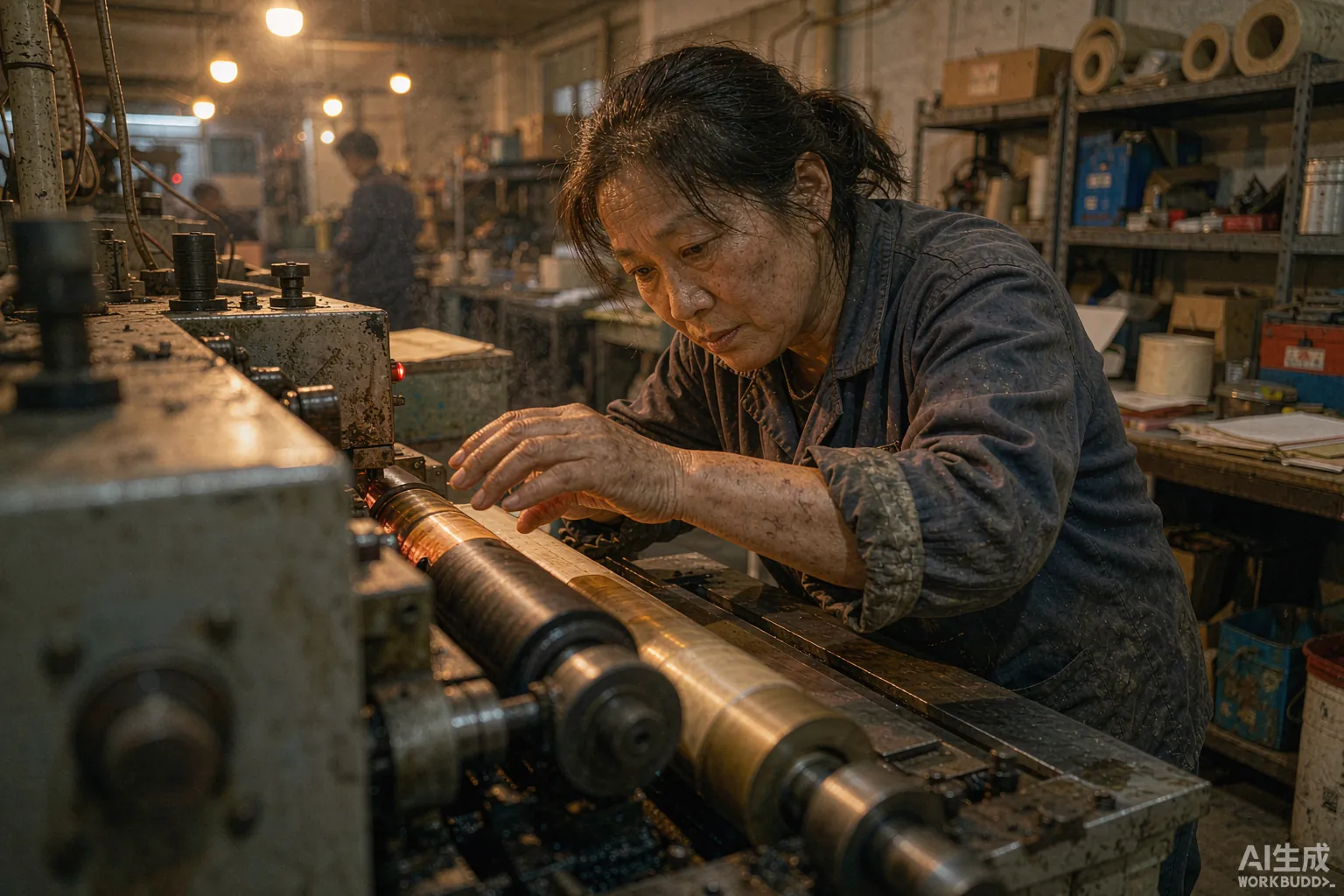
A Zhen is the only woman on the foil-stamping line. She has been, for eleven years.
She is 【待填:年龄】, from 【待填:籍贯】. She came to Dongguan in 【待填:来莞年份】with a suitcase, a junior-high diploma, and a phone number of a cousin who worked in a printing factory. She did not know what foil-stamping was. She knew she needed a job.
Now she is the one they call when the machine cannot get it right.
The machine is not always right.
A foil-stamping machine is a precise thing. It heats a metal plate, presses it against a ribbon of gold foil, and leaves a shining mark on the paper. Set the temperature too high, and the foil blurs, bleeds past the edge, turns dull. Set it too low, and the mark is weak, incomplete, a shadow of itself.
The machine has a dial. The dial says a number. The number is a lie — or rather, it is a suggestion. Because the right temperature is not a fixed thing. It changes with the paper, with the ink beneath, with the humidity in the air, with the age of the plate, with the hour of the day.
A Zhen does not trust the dial. She trusts her hand.
Before a run, she holds her palm above the plate, close but not touching, and she feels the heat rising. She does this the way a cook holds a hand over a pan — not to measure, but to know. Her hand has learned, over eleven years, the exact feel of a hundred and ten degrees, of a hundred and twenty, of the narrow band in between where gold turns perfect.
"The dial says one thing," she says. "The hand says another. I go with the hand."
How she learned.
She learned the way everyone in this factory learns — by doing it wrong, and being told, and doing it again.
Her first master was a man named 【待填:师傅的称呼】, who had been stamping foil since before she was born. He did not teach her with words. He taught her by making her stand beside the machine, hour after hour, and feel. He would set the temperature wrong on purpose, and make her tell him, by hand alone, whether it was too hot or too cold.
At first she was always wrong. Then she was sometimes right. Then, one day, she was right every time, and her master nodded, and said nothing, and that was how she knew she had learned it.
It took her three years.
"He never said 'good,'" she says. "He just stopped correcting me. That's when I knew."
A woman's hands.
They did not expect her to last. This is heavy work, and hot, and the line was all men. They gave her the easy jobs at first — the simple marks, the flat surfaces, the work that did not need the hand.
She asked for the hard ones.
She asked because she wanted to learn, and because she was stubborn, and because she had a daughter back home, 【待填:女儿的年龄】years old, who needed school fees and shoes and a mother she could be proud of. She did not say this last part. She just said, "Let me try."
She burned her hands, at first. Everyone does. The plate is a hundred and ten degrees, and the work is fast, and a moment's inattention leaves a mark. She has the small white scars still, on her fingers, on the back of her left hand. She does not hide them.
"The first year, I cried after every shift," she says. "Not because it hurt. Because I was afraid I would never be good enough."
She was good enough. Now she is the best.
What she holds up.
A Zhen's daughter is 【待填:女儿的年龄】now, in 【待填:年级/学校】. She is a good student. She wants to be a 【待填:女儿的理想职业】. A Zhen sends money home every month, and calls every Sunday, and tells her daughter to study hard and not to worry about anything.
Her daughter does not know what her mother does, exactly. She knows her mother works in a factory in Guangdong, and that the factory makes boxes, and that the boxes are beautiful. She has seen one — her mother brought one home, once, a perfume box with a gold pattern that A Zhen had stamped herself.
The girl kept it. She keeps her pens in it.
A Zhen does not know this. Her daughter never told her. But the box is on the girl's desk, eleven years later, still holding pens, still holding the gold pattern that her mother's hand, at a hundred and ten degrees, pressed into the paper.
The hand and the dial.
This morning, the machine is stamping a run of jewelry boxes — small, delicate marks, a floral pattern in gold, the kind of work that separates the good from the great. The dial says a hundred and fifteen. A Zhen holds her hand above the plate. She frowns.
"One-twelve," she says. "The plate's old. It holds heat. One-twelve, or it'll blur."
The new man adjusts the dial. The run begins. The marks come out clean, sharp, perfect — the gold sitting on the paper like it grew there.
A Zhen watches the sheets come off, one by one. Her face does not change. But her hand — her right hand, the one with the small white scars — rests on the edge of the machine, and her fingers tap, once, twice, a small satisfied rhythm.
It is the only sign she gives that she is pleased.
She will stamp ten thousand boxes today. Each one will carry a mark that her hand, not the dial, made true. And somewhere, in one of those boxes, in a city she will never see, someone will open a gift, and see the gold, and not know that a woman in Dongguan held her hand above a plate, and knew, without a single instrument, that it was three degrees too hot.
Eleven years.
At six, the shift ends. A Zhen cleans her station, covers the machine, washes the ink and the day from her hands. The scars stay. The gold does too, faintly, at the edges of her nails.
She calls her daughter from the dormitory. They do not talk long — the girl has homework, and A Zhen is tired. But before she hangs up, A Zhen says the thing she always says, the thing she has said every Sunday for eleven years:
"Study hard. Don't worry about anything. Mama's here."
Then she hangs up, and she looks at her hands, and she flexes her fingers, and she goes to make her dinner.
Tomorrow, the dial will lie again. And again, her hand will be right.
Profile 2 of "The People" series — the only woman on the foil-stamping line, and the one they call when the dial cannot get it right.