 English




S4-2: Arabic Calligraphy: An Art Written on Boxes
Published: 2026-09-05 | Series 4: The World — Calligraphy | Reading time: 7 minutes
Arabic Calligraphy: An Art Written on Boxes
There is an art form in which the tool is a reed pen, the canvas is anything that holds still, and the masterpiece is a single word.
It is Arabic calligraphy. And once you have seen it — really seen it, the way a letter can stretch like a horizon or coil like smoke — you begin to understand why, in much of the world, a box is not finished until something beautiful is written on it.
Where writing became art.
Every culture writes. But not every culture turned writing into its highest visual art. In the Arabic-speaking world, the written word carries a sacred weight, and over more than a thousand years, calligraphers answered that weight with astonishing invention. Letters were lengthened, braided, mirrored, stacked into arches and woven into circles, until the boundary between reading and seeing dissolved.
A line of Arabic calligraphy is not read the way a sentence is read. It is approached the way a garden is approached: you enter, you wander, you notice.
The masters of the line.
Over the centuries, distinct styles emerged, each with its own temperament. There are scripts that stand tall and solemn, like architecture. There are scripts that flow diagonally, like water running downhill. There are scripts so precisely geometric that every curve can be drawn with a compass, and scripts so free they seem to be dancing.
To a calligrapher, these are not fonts. They are voices. Choosing a script for an occasion is like choosing music for a ceremony — the same words, in a different script, say something entirely different.
The rule and the freedom.
What looks like pure flourish is, in fact, governed by strict discipline. Classical calligraphy is built on proportions: letters measured in dots, curves measured against the height of a single vertical stroke. A master trains for years before the hand can be trusted with freedom.
This is something we recognize instantly, in our own workshop. The most effortless line is the most practiced one. Freedom on the surface, discipline underneath — it is the signature of every true craft, whether the tool is a reed pen or a foil-stamping die.
When calligraphy meets a box.
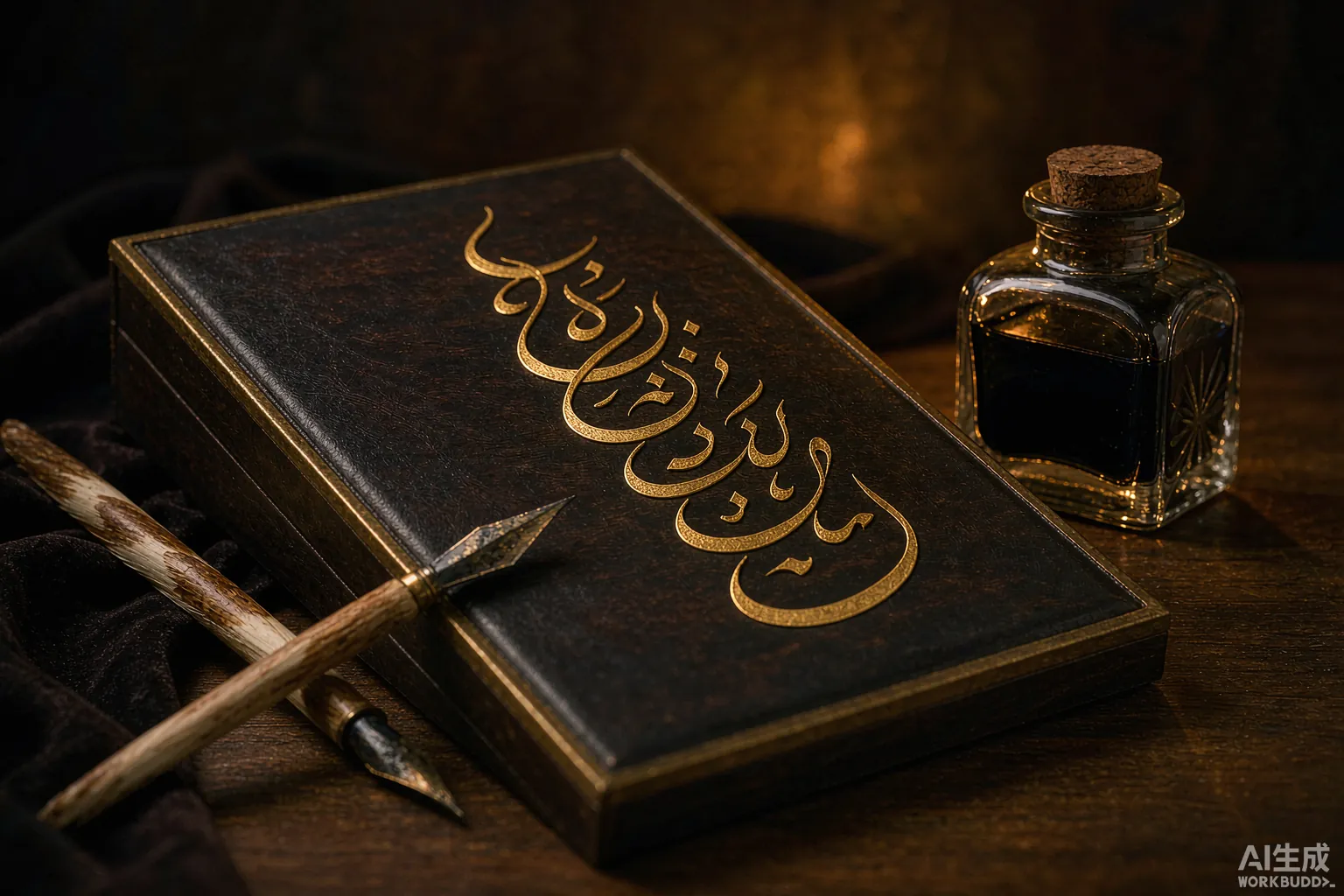
A gift box is, among other things, a small piece of architecture with six flat canvases. When calligraphy arrives on that canvas, something fortunate happens. The box gives the writing a stage — a lid that opens like a curtain. The writing gives the box a soul — a blessing, a name, a line of poetry, pressed in gold.
This is why, across the Middle East, some of the most treasured boxes are the simplest ones: a deep-colored box, and on its lid, a single word beautifully written. A name. A greeting. Sometimes just the word for "gift" itself — because in a culture that elevated handwriting into art, the most luxurious decoration is not a pattern. It is a word, written by someone who spent a lifetime learning how.
Two traditions of the beautiful line.
There is a quiet kinship here that delights us. China, too, is a civilization that decided long ago that writing could be the highest art. Our calligraphers also spent lifetimes on the movement of a single stroke. Our boxes, too, have carried written blessings for a thousand years.
Two great traditions of the beautiful line, growing on opposite ends of the same continent, rarely meeting — until a box travels from one to the other, and the two ways of loving the written word finally share the same small canvas.
What a written word leaves behind.
A printed pattern decorates a box. A calligraphed word consecrates it. Long after the gift inside is enjoyed, people keep boxes that carry beautiful writing — because throwing away a beautiful word feels wrong, in any language.
And perhaps that is the lesson this art teaches everyone who makes things: a box can carry many kinds of decoration. But the decoration people keep is the one that speaks.
Profile 2 of Series 4 — on the art that becomes the surface of every fine Arabic box, and the four scripts that travel from parchment to perfume.